 Home
Home Sign in
 Bitcoin price
 Ethereum price
 Cardano price
 Chainlink price
 Solana price
 Uniswap price
 Avalanche price
 Wallet
 Fees
Fees Exchange
 Business
 Luno API
 Discover
 Help Centre
 Status
 Company
 Careers
 Press
Press


Did an AI agent just burn millions in BTC?
 Team Luno
Probably nothing by Luno

Source: Gemini
THE WEEK IN MARKETS
It’s still all about the oil. The trend of the past few weeks has been President Trump saying there’s progress on the standoff between Iran and the US regarding the opening of the Strait of Hormuz and letting the shipment of oil, gas and other goods flow again, only for progress to dematerialise and fall back into a stalemate. US officials last week said, as per the NY Times, there’s progress toward “a memorandum of understanding”. Add to this slight cracks starting to appear in the US economy around inflation and consumer spending, and it’s a bit of a muted affair in markets, seeing the Fed’s dovish approach flap further away towards the horizon.
From Schwab: “The consumer engine is showing cracks. Real consumer spending nearly stalled at 0.1%, while the personal savings rate dropped to a nearly four-year low, suggesting households are absorbing persistent inflation with less cushion.”
Bitcoin and Ethereum each slipped 5% or more during the course of the week, the majority of those losses coming over the weekend. On the other hand, US stocks continue to print green candles, with the S&P 500 having another strong week with record highs. The AI growth theme is one of the obvious insulations here against the bearish backdrop, but some analysts say markets could be pricing in an agreement between the US and Iran. Moneyweb reports: “There are likely going to be more setbacks, but the market has already priced in an agreement in Iran,” said Patrik Lang, chief investment strategist at Geneva-based Global Gate Asset Management. “I wouldn’t expect big market moves, except maybe lower oil, once the deal is announced.”
The rate of change in this situation is reason enough to keep a close eye on it.
WHAT’S UP 🔥: S&P 500 | +1.45% | 7 days
WHAT’S DOWN 💧: Bitcoin | -5.8% | 7 days
You buying the S&P 500 rally? Do it in local currency on Luno 👉 HERE.
Buying BTC on the way down? Also on Luno, right 👉 HERE.
*Tokenised stocks are only available to Luno customers in South Africa and Nigeria.
Data correct as at 01 June 2026, 07h40 GMT.
THE BIG READ
Someone, or something, put a torch to $7.8 million in Bitcoin
In 1994, British electro band KLF travelled to the remote Scottish Isle of Jura and ceremoniously set fire to about £1 million, a mountain of burning cash symbolising the band’s retirement, or something like that. They caught it all on film.
Someone did the same with their Bitcoin bag last week, sending 107 Bitcoin that had been dormant for 11 years to a burn wallet – a wallet with no private keys, meaning it can receive funds but those funds can never be retrieved. Cruelly, the blockchain records everything. The BTC is there for all to see, but can never be touched. And so, of course, blockchain research firm Galaxy proffered a few thoughts, although a few of them not very good ones by their own admission.
Theories floated include:
- Tax loss harvesting, wherein the burner thinks they can offset gains by burning the BTC
- Religious reasons, like a vow of poverty
- Getting rid of evidence, as in BTC obtained through dubious means
- A rogue AI agent, which is probably the most likely, say the team, and also the most terrifying. Imagine an agent under your employ incinerating millions of dollars. Oops.
Analysts estimate that between 2.3 million and 3.7 million Bitcoins have been permanently lost, roughly 11-18% of the fixed 21 million supply, with some reports placing that figure as high as 4 million BTC. Of the approximately 19.8 million BTC mined to date, the amount realistically in circulation sits closer to 15.8–17.5 million once lost coins are accounted for. The maximum supply hasn’t changed.
If it turns out the offering was at the hands of a bot, there’s something poetic about the latest burning of digital money by a digital trader. That’s 107 fewer Bitcoins in circulation.
PICTURE THIS
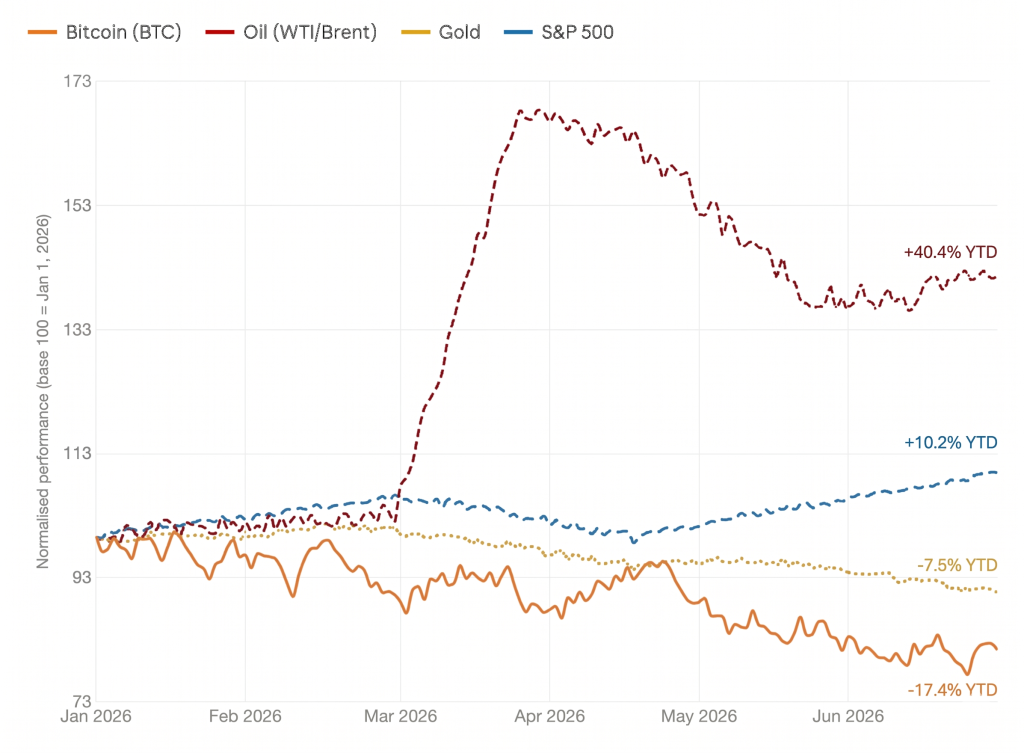
Source: Market data sourced from Google Finance, Trading Economics, and DailyForex as of June 2026.
The defining story of 2026 starts in the Strait of Hormuz. In March, following US and Israeli strikes on Iranian military infrastructure, Iran shut down the strait, the chokepoint responsible for roughly 20% of global oil and LNG shipments. The price of oil went from $64 to over $90 a barrel, a 40% move that reverberated across every asset class. Gold, the traditional wartime refuge, spiked and has since softened. Equities have been the winner, with the S&P 500 quietly grinding 10% higher on AI optimism while the macro picture deteriorated everywhere else. Bitcoin tells a different story. It’s down about 18% since the start of the year, caught between inflation fears, a hawkish Fed, and a market still making up its mind about whether digital assets are a safe haven or a risk-on trade.
QUICK TAKES
🔷 Is Ethereum’s staking model under pressure?
For the first time, more than one-third of all ETH supply is now staked. The current reward curve was built for a 20-25% staking target, but liquid staking tokens and growing institutional adoption have pressured that assumption. Researchers are split into three camps: reform the issuance curve to cap growth, preserve the existing model to protect DeFi’s collateral base, or tackle the root cause of Ethereum’s declining L1 fee capture as activity shifts to L2s. The debate has moved from research forums firmly onto the active protocol roadmap. – Read more
✅ SEC greenlights Nasdaq Bitcoin index options
The SEC approved Nasdaq to list European-style, cash-settled Bitcoin index options on the Philadelphia Stock Exchange on 23 May, trading under the ticker QBTC. The contracts give institutions regulated BTC exposure without requiring direct asset custody, another step in the mainstream integration of crypto into traditional financial markets. – Read more
💰 Berkshire’s $400bn cash pile is a market signal worth watching
Berkshire Hathaway reported holding approximately $400 billion in cash at the end of Q1 2026, the largest cash reserve any American company has ever held. Reporting in the American Banker frames a cautionary signal. A company that generates returns by deploying capital, sitting on its largest-ever uninvested reserve, suggests leadership sees few attractive opportunities at current valuations. In the post-Buffett era, Berkshire has also been narrowing its banking sector exposure, selling stakes in Visa and Mastercard while retaining positions in American Express, Ally, and Capital One. Historically, when Berkshire eventually deploys that powder, it tends to be because markets have fallen sharply. – Read more
TOWN HALL
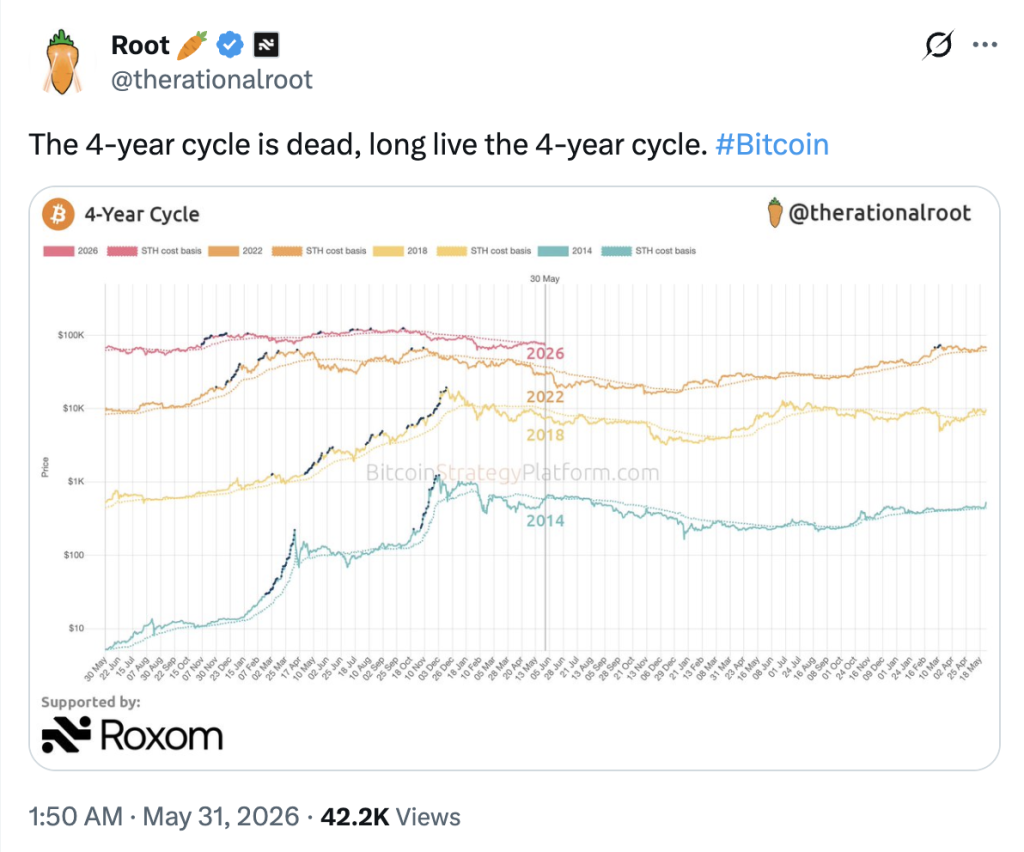
Source: https://x.com/therationalroot/status/2060871436303315376
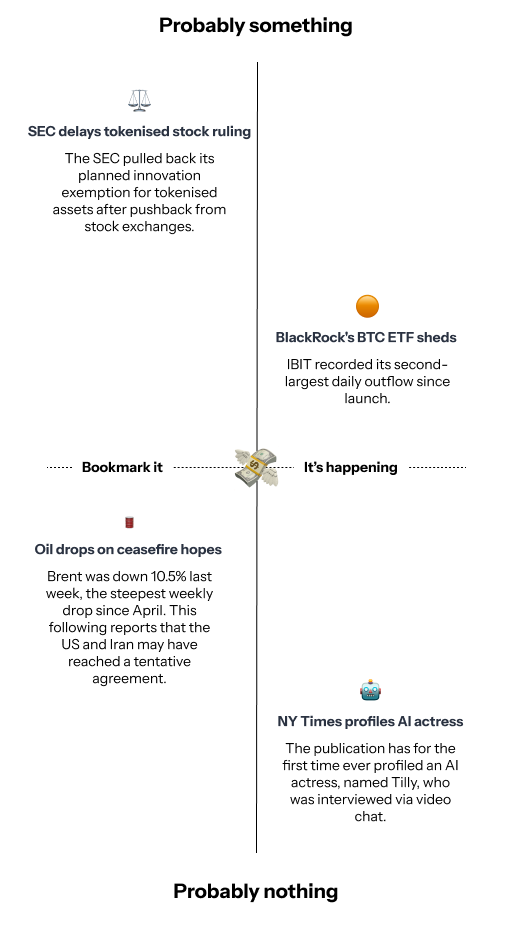
PROBABLY SOMETHING
*Investing in cryptocurrency may result in the loss of capital. This information should not be construed as a solicitation to trade. All opinions, news, research, analysis, prices or other information is provided as general market commentary for information purposes only and is not investment advice or recommendation. Luno always advises you to obtain your own independent financial advice before investing or trading in cryptocurrency.
Did you find this useful?