
 Home
Home Sign in
 Bitcoin price
 Ethereum price
 Cardano price
 Chainlink price
 Solana price
 Uniswap price
 Avalanche price
 Wallet
 Fees
Fees Exchange
 Business
 Luno API
 Discover
 Help Centre
 Status
 Company
 Careers
 Press
Press


Is the SaaSpocalypse a thing?
 Team Luno

THE WEEK IN MARKETS
It was a mixed week in geopolitics and crypto. The US-Iran peace framework hit immediate turbulence after the publicised signing in Switzerland, with a joint “roadmap” now the working plan to turn a fragile ceasefire into a lasting deal within 60 days. Meanwhile, Kevin Warsh chaired his first Fed meeting and left rates unchanged. The updated dot plot has officials pencilling in rates mostly between 3.5% and 4.0% for the rest of the year.
Bitcoin dipped to around $62K before recovering to roughly $64K to start the week, down just over 2% across seven days. Not everything followed. Solana gained more than 3% over the same period, a reminder that this is a market that rarely moves as one.
🔥 WHAT’S UP: Solana | +3.6% | 7 days
💧 WHAT’S DOWN: Zcash | -7% | 7 days
Data correct as at 22 June 2026.
THE BIG READ
What is the SaaSpocalypse and why are investors terrified?
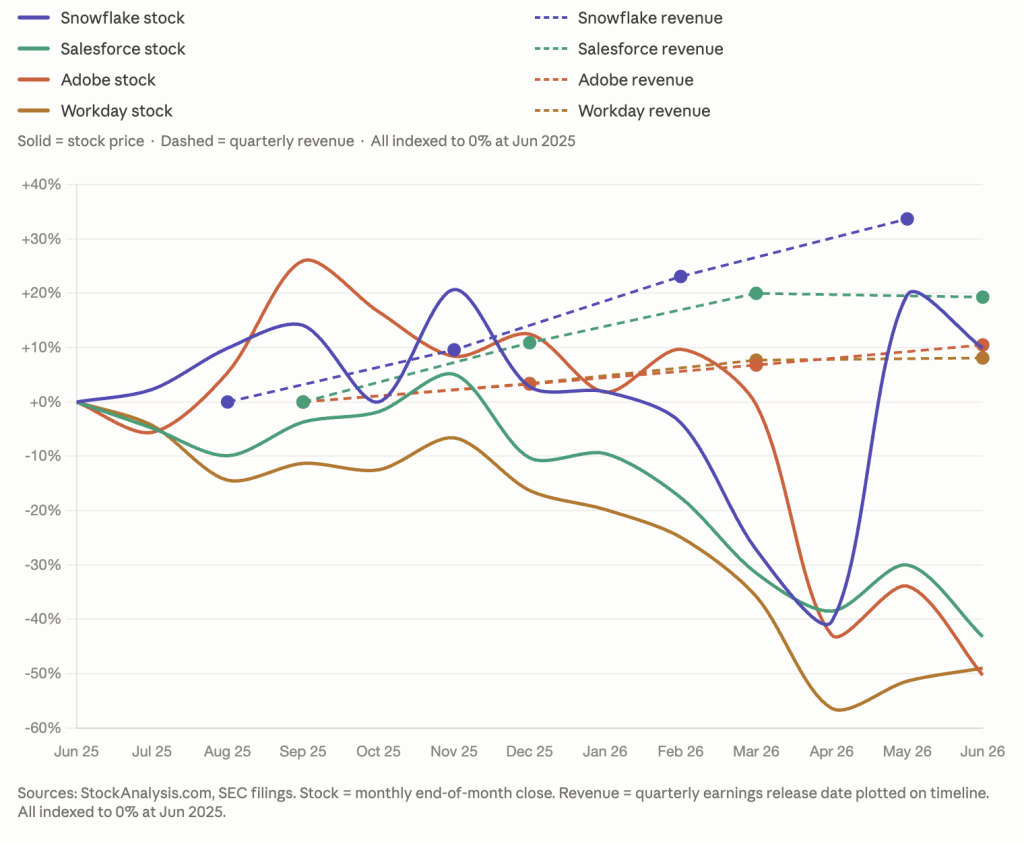
Equity analysts rely on data when picking stocks, which is why there must be more than a few scratching their heads right now when looking at the data.
So, a quick stock take of software-as-a-service companies.
- Snowflake — down 44% since 1 January
- Salesforce — down 37% year to date
- Adobe — down 35% year to date
- Workday — trading 42% below its 52-week high
Collectively, this rolling selloff has erased approximately $2 trillion from software market values since late 2025. Wall Street even has a name for it: the SaaSpocalypse.
It’s strange, though, because many of these companies continue to post healthy revenue numbers. Adobe just posted record Q1 FY2026 revenue of $6.4 billion, up 12% year on year, with AI-first ARR more than tripling and subscription revenue growing 13%. HubSpot clocked $881 million in Q1 2026, up 23% year-on-year, flipping from an operating loss of $27.5 million to a profit of $27.9 million in twelve months. Salesforce beat Wall Street estimates on $9.83 billion in quarterly revenue. Workday and Snowflake both raised full-year guidance.
What’s putting the fear into markets?
It’s AI. The theory goes that AI agents threaten the per-seat licensing model that has underpinned SaaS growth for a decade. If companies deploy AI agents that reduce headcount, the number of software seats shrinks, and with it the annual recurring revenue (ARR) that justified sky-high evaluation multiples. A survey of Chief Information Officers found that 40% of IT budgets are being reallocated from legacy SaaS subscriptions toward agentic platforms and LLM token usage. The doomsday math writes itself, with fewer people using software it means fewer licenses, which, in theory, means the entire business model cracks.
But the early data is starting to complicate the narrative. Snowflake, a cloud data platform that lets enterprises store, analyse, and share data across cloud environments at scale, just reported that AI accounts on its platform jumped from 9,100 to 13,600 in a single quarter, product revenue grew 34%, and full-year guidance was raised by $180 million. Goldman Sachs has argued the selloff reflects a sentiment shift rather than a real deterioration in fundamentals. Analyst Matthew Martino put it plainly: “We recognise that rapid AI innovation creates legitimate uncertainty and warrants a higher risk premium… Even so, we believe the repricing has been applied broadly rather than selectively.” And Snowflake’s results suggest something the market has not fully priced in yet: enterprises are not replacing SaaS with AI. They are using AI on top of it. Adobe tells the same story. AI-first ARR tripled year-on-year in its most recent quarter, with the company posting record revenue while its stock sat 35% in the red.
Meanwhile, the same investors fleeing profitable software companies are piling into AI plays trading at eye-watering multiples. SpaceX commanded over $1.7T in market value on its IPO day, while delivering $18.7B in revenue and a net loss of $1.9B. Anthropic has sprinted from $9 billion to a $30 billion revenue run rate in under a year at a near-trillion dollar valuation.
The fundamentals say one thing. The market is saying something else entirely. Somewhere between those two truths, the real story of new age tech is still being written.
PICTURE THIS
Source: https://www.federalreserve.gov
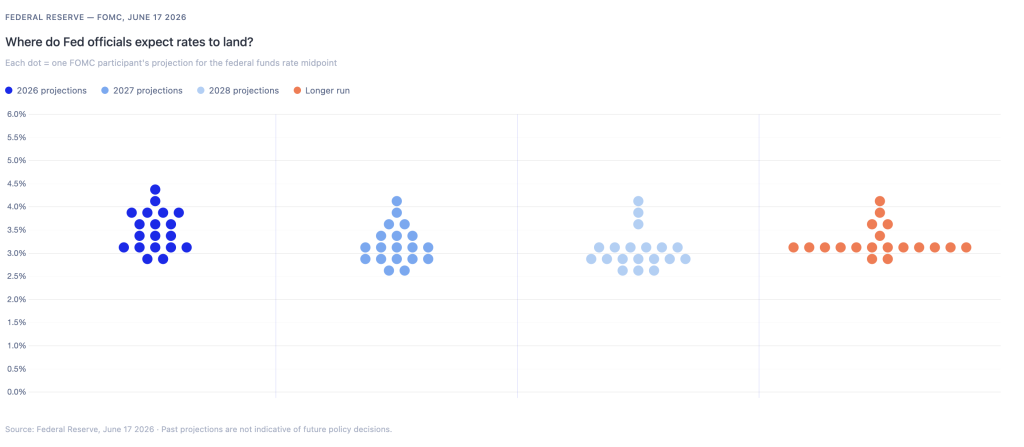
The latest dot plot chart from the Federal Reserve is a direct map of official monetary policy expectations. It plots where the 19 individual members of the Federal Reserve’s decision-making committee believe the central bank’s benchmark interest rate needs to sit to keep the US economy stable.
The 2026 cluster sits mostly between 3.5-4.0%, suggesting the committee expects rates to stay elevated through year-end. The distribution spreads and shifts lower as you move to 2027 and 2028, with the longer run converging around 3.0–3.25%, which is the market’s rough estimate of the neutral rate under the new Fed Chair Kevin Warsh.
A hawkish shift in the Fed’s dot plot alters the foundational math that governs how stocks and crypto are priced. When policymakers signal that interest rates will remain higher for longer, or potentially increase, it directly impacts financial markets through two primary economic mechanisms: the cost of capital and the discount rate. Crypto markets can be highly sensitive to central bank policy because they generally perform better when there’s an increase in global liquidity.
QUICK TAKES
😥A tentative peace deal
The US and Iran wrapped up talks in Switzerland early Monday with something worth watching: a joint “roadmap” aimed at turning a fragile ceasefire into a lasting deal within 60 days. Qatar and Pakistan, who’ve been doing the diplomatic heavy lifting as mediators, made the announcement after 3am local time. The two sides agreed to a temporary communication line to prevent accidental escalation, think a hotline for when things get tense, and a safe passage mechanism for ships moving through the Strait of Hormuz, which matters a lot for oil prices and, by extension, everything else. A “de-confliction cell” to wind down the Israel-Hezbollah front in Lebanon was also on the table. Whether this holds is the open question. But for now, the machinery of a deal is at least in place. – Read more
🏦 The Fed held
The Fed held rates steady at 3.5%-3.75% in Kevin Warsh’s first meeting as chair. No surprises there. What was notable was what changed around the decision: the Fed’s statement got a dramatic haircut, stripped of the language that previously hinted at future rate cuts. Warsh also sat out the dot plot, the closely watched grid where Fed officials signal where they see rates heading, and announced he’d be forming task forces to overhaul how the Fed operates. In other words, the rate didn’t move, but the institution is being rearranged. Markets will be reading the tea leaves on what a shorter, less committal statement means for the rate path from here. – Read more
🔓 Japan corporate pension fund to allocate crypto
Japan’s National Business Corporate Pension Fund, managing roughly ¥21.3 billion for about 1,200 small and medium-sized companies, is heading into crypto. Starting fiscal 2026, it plans to put around 1% of its assets into a passive multi-crypto fund run by a major hedge fund. The reason? The fund’s investment chief said the dollar may lose its reserve currency status, so rather than raising dollar exposure, the fund is trimming yen holdings from 80% to 70% and routing the freed-up allocation into developed-market currencies, gold, and crypto. Six years of research went into this decision. – Read more
TOWN HALL
Source: https://x.com/JSeyff/status/2067717785455579576
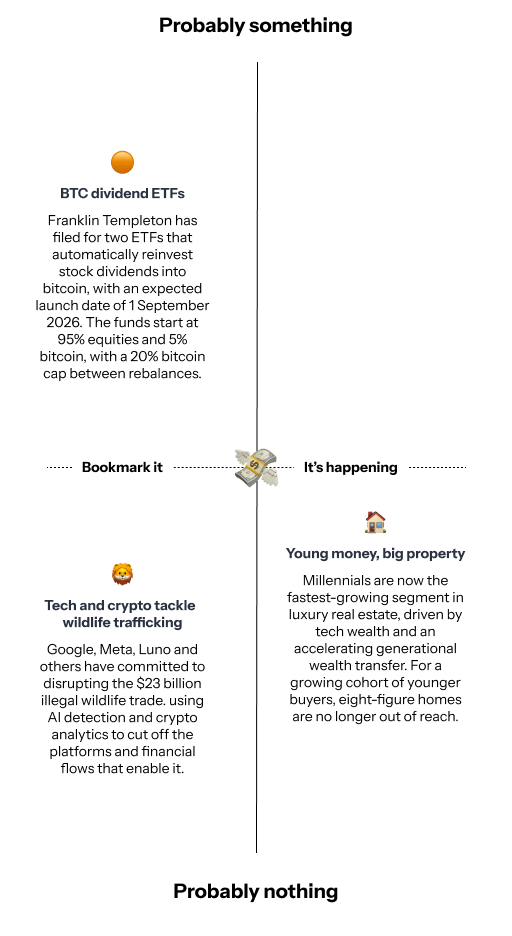
PROBABLY SOMETHING
*Investing in cryptocurrency may result in the loss of capital. This information should not be construed as a solicitation to trade. All opinions, news, research, analysis, prices or other information is provided as general market commentary for information purposes only and is not investment advice or recommendation. Luno always advises you to obtain your own independent financial advice before investing or trading in cryptocurrency.
Did you find this useful?