
 Home
Home Sign in
 Bitcoin price
 Ethereum price
 Cardano price
 Chainlink price
 Solana price
 Uniswap price
 Avalanche price
 Wallet
 Fees
Fees Exchange
 Business
 Luno API
 Discover
 Help Centre
 Status
 Company
 Careers
 Press
Press


DeFi comes to Luno: Aave, Curve and Maker now available to buy, store and explore
 Team Luno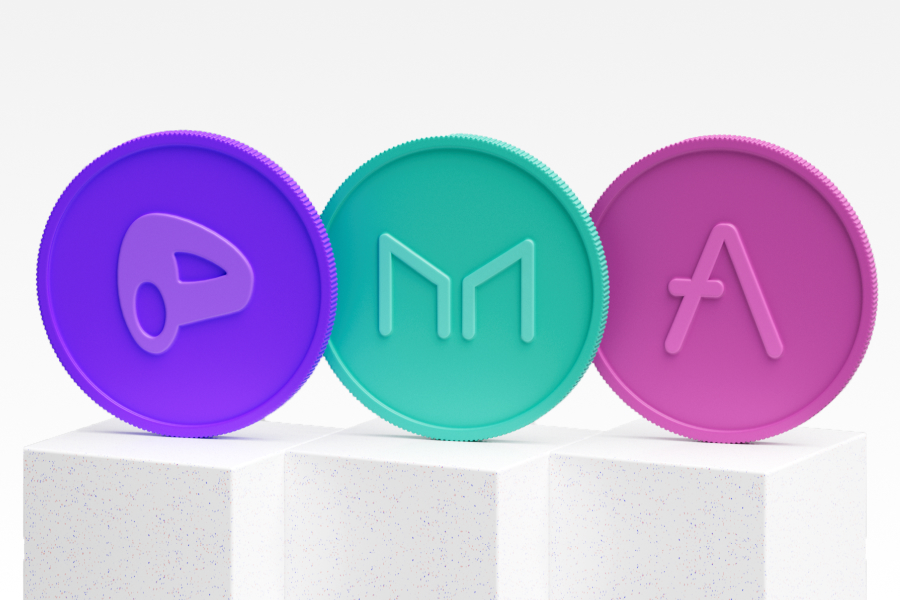
We’ve added three new cryptocurrencies to invest in with Luno: Curve, Maker and Aave, each giving you access to the emerging world of Decentralised Finance (DeFi).
The number of DeFi users in the world was estimated to be roughly 4.8 million in 2022, and that number is set to exceed 22 million users by 2028 at current growth trends. The Total Value Locked (TVL) in DeFi, meanwhile, hit more than $52.71 billion last year. This makes it one of the more mature use cases for crypto technology today. But what is DeFi, and is it an area worth considering for investment?
What is DeFi?
Imagine you could bypass traditional financial institutions to access services like loans, savings, insurance or trading. DeFi is an innovative financial system established and operated on public blockchains. It is an ecosystem of applications that enable permissionless financial services using smart contracts to automate transactions.
What this essentially means is that anyone has access to these services, irrespective of their wealth, location or any other obstacle put in place by traditional institutions. Banks, for example, can currently control access to services and have the power to potentially block clients or close their accounts, whereas blockchains are censorship-resistant, making the above all but impossible from happening inside these decentralised systems.
DeFi in action
DeFi has a number of use cases. To date, the biggest one has been decentralised lending and borrowing. DeFi platforms such as Aave connect borrowers and lenders directly, eliminating the need for credit checks, instead allowing borrowers to put up cryptocurrency and other digital assets as security.
What is collateralised borrowing?
Let’s look at collateralised borrowing as an example of DeFi in action. Borrowers must lock up collateral greater than the value of the amount they’re borrowing. The collateral is a safeguard, ensuring lenders will be repaid if a borrower defaults on the loan. In DeFi, these kinds of transactions are generally automated and enforced by smart contracts, protecting both the lender and borrower before they lose out on money, or more money than they put up as collateral.
What could this look like?
- Let’s say you want to borrow $100 worth of BTC.
- To get access to this capital, you would have to lock up more than $100 of another asset as collateral.
- If, for example, you, the borrower, chose to lock up $150 of ETH and default on the loan, the lender can seize this ETH, worth more than the amount on loan.
- This works to mitigate the risk of a borrower not repaying the loan amount, as they’d be losing more. And all of this can be automated using smart contracts, without the borrower or lender having to do anything.
There’s an important accommodation for crypto’s volatility. The price of both BTC and ETH can change over time. For example, if the price of ETH falls and your collateral is worth only $90, the lender wouldn’t be able to get their money back by seizing your ETH because it’s less than the amount borrowed. This is where liquidation comes into play.
Liquidation is essentially when your loan is automatically repaid by selling some of your collateral to buy back the asset you owe to the lender. Liquidations occur if your loan falls below the required level of collateralisation, which is usually between 115% – 150%.
What are the risks?
As with any nascent industry, there is always risk. Factors like low liquidity may hinder the completion of transactions for DeFi products. Even when DeFi applications manage to welcome billions of people to its platforms, the public blockchains they rely on could lack the capacity to accommodate an increase in demand.
At Luno, we want you to feel empowered to make the right investment decisions. We recommend that you do your own research before investing in any cryptocurrency. You can read more about how we assess and list cryptocurrencies here.
Aave, Curve and Maker are among the prominent cryptocurrency projects operating in DeFi at the moment, an industry that has potential to change finance as we know it. Learn more about these cryptocurrencies below.

Read more
What is Aave
What is Curve
What is Maker
*Investing in cryptocurrency may result in the loss of capital as the value can fluctuate. This information should not be construed as a solicitation to trade. All opinions, news, research, analysis, prices or other information is provided as general market commentary for information purposes only and is not investment advice or recommendation. Luno always advises you to obtain your own independent financial advice before investing or trading in cryptocurrency.
Did you find this useful?